
Insights
Articles
9 February 2026
7 min read
AI Has Moved Beyond the Chatbot: Is Your Stack Ready for Agentic Workflows?
Praise Ohans
Author
Introduction
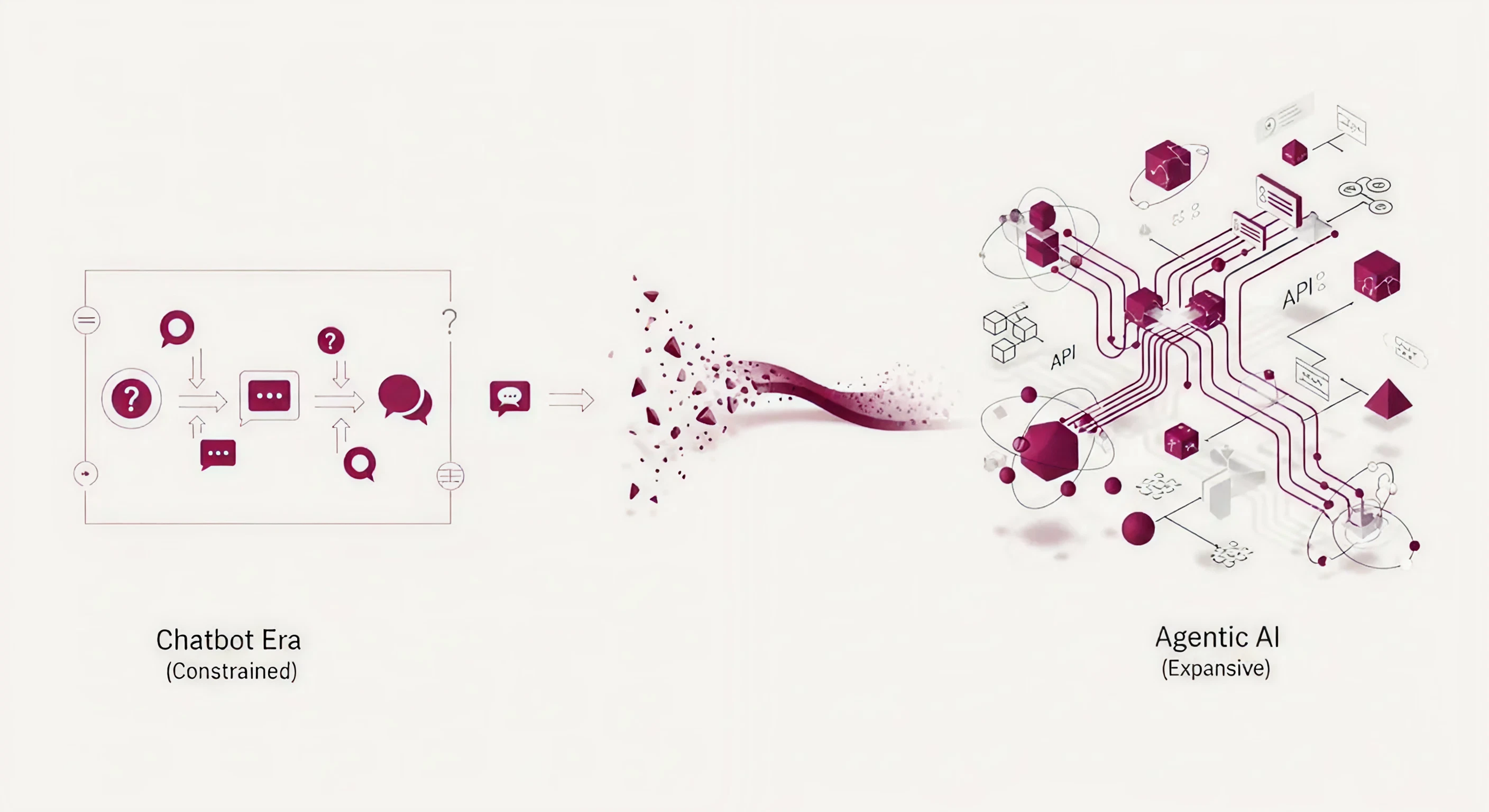
Most enterprises began their AI journey with chatbots, since they were once seen as the obvious starting point. Customer support bots, internal Q&A tools, and conversational interfaces were easy to deploy and deliver returns. However, chatbots are somewhat limited as they respond to prompts but fail to plan, execute, or coordinate work across systems. This limitation is why many organizations struggle to translate chatbot adoption into measurable business impact.
Unlike chatbots, autonomous AI agents reason through specific tasks, decide on next steps, call APIs, interact with enterprise systems, and complete end-to-end workflows. This development marks the move from AI as an interface to AI as an operator within business processes. Hence, it comes as no surprise that 40% of enterprise applications will integrate task-specific AI agents by 2026.
Frameworks such as the NIST AI Risk Management Framework and EU AI Act requirements demand transparency, and accountability. Chatbots are easier to tolerate as they often operate in isolation. Autonomous agents operating across systems require deliberate governance by design. This raises the big question many leaders are now asking: is my AI stack ready for agentic workflows, or is it still optimized for yesterday’s AI use cases?
The Four Pillars of Enterprise AI Readiness
1. Agentic AI & Orchestration
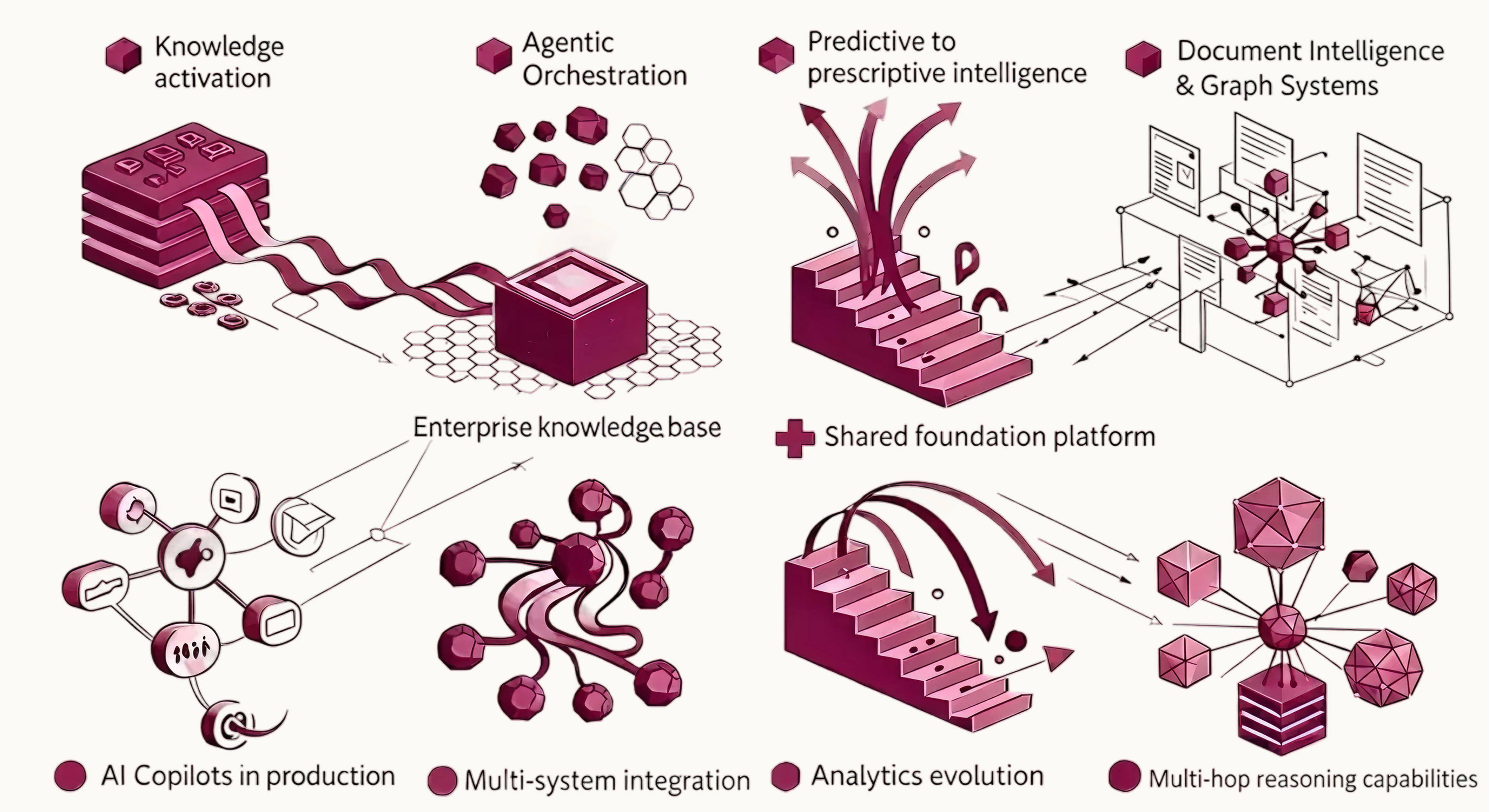
Most enterprise automation today is rigid. Workflows follow predefined instructions and fail when conditions are changed. Agentic AI systems operate differently by adapting execution based on context and outcomes. Agentic systems are designed to handle multi-step workflows across tools and teams. For example, instead of responding to a single request, they coordinate actions across systems such as CRMs, data platforms, and internal tools. Deloitte’s 2025 research shows that only 11% of organizations have deployed agentic AI systems in production, yet those that have report business process acceleration of 30 - 50%.
What makes this possible is how they are orchestrated. AI orchestration tools manage how agents sequence tasks, share state, and interact with enterprise systems. Without orchestration, agents operate in isolation, affecting enterprise visibility, and control across complex workflows.
Human in the loop checkpoints are non-negotiable. AI should never be deployed to completely replace humans, but to compliment them. This is why agentic AI systems require checkpoints where humans can review decisions, approve actions, or intervene when risk thresholds are reached. When Morgan Stanley deployed AI driven tools for financial advisors, the inclusion of human oversight enabled advisors to save 10 to 15 hours per week per advisor without compromising decision quality.
At Gozade, autonomous AI agents are built for production environments. Agents are designed to plan tasks, call APIs, and coordinate workflows while operating within defined governance boundaries. Every deployment includes auditability, performance measurement, and compliance controls from day one. We turn your processes into intelligent systems that get work done.
2. AI Copilots in Production
It is true that AI copilots are everywhere. It is also true that most of them aren’t delivering real value. After all, two truths can co-exist, right? The copilot market hit $7.2 billion in 2025, powered by tools like ChatGPT Enterprise, Claude for Work, and Microsoft 365 Copilot. However, adoption tells a different story. Only 1.8% of Microsoft 365 users have upgraded to paid Copilot plans, and nearly 75% of organizations can’t point to measurable business impact.
Want to hear another truth? The problem isn’t the assistant, it’s the setup. Enterprise AI assistants are only as useful as the information they can access and interpret. When copilots are deployed without structured enterprise knowledge management, they provide shallow answers that do nothing to improve execution. Without institutional knowledge, copilots are no better than generic Q&A tools.
What works in production are role-aware AI assistants embedded directly into how teams already work. This requires converting tribal knowledge into structured formats, defining use cases by role, and training teams on how to work with AI assistants effectively.
At Gozade, we help companies onboard AI assistants like ChatGPT Business and Microsoft Copilot by first converting SOPs and tribal knowledge into structured, accessible formats. We ensure your team's AI copilot adoption exceeds industry benchmarks, with proper training, use-case mapping, and continuous optimization.
3. Predictive and Prescriptive Analytics
Most organizations already have analytic dashboards that show past reports and summarize trends. This is descriptive analytics. It explains the past but does not influence future outcomes. However, enterprise value relies strongly on analytics systems that move beyond description.
Predictive analytics platforms estimate what is likely to happen next based on historical and real-time data. They forecast demand, identify impending risks, and anticipate operational pitfalls. Many enterprises invest here, but prediction alone still isn’t enough to offer massive value.
Prescriptive AI systems complete the analytics cycle. They recommend what should be done and, in advanced cases, trigger actions automatically. This is where AI driven decision making systems deliver measurable impact. In 2025, 60% of organizations say predictive analytics is a priority. However, only 10% have moved beyond prediction into prescriptive analytics that recommends clear actions. The gap between these systems is profound. Teams that employ prescriptive analysis report revenue gains of 10 to 15% and cost reductions between 5 and 10%.
At Gozade, our models don't sit in labs; they live in your production environment. We help you transition from descriptive analytics to predictive and prescriptive intelligence that drives real-time ROI, whether you're optimizing supply chains, forecasting customer churn, or managing risk.
4. Document Intelligence with RAG and GraphRAG
Most enterprise values lie in documents. Contracts, manuals, internal emails, policies, and technical documentation contain the foundation that runs the business. Without document intelligence, this data becomes unusable. Retrieval Augmented Generation has become the standard framework for enterprise knowledge assistants in 2026. RAG allows AI systems to retrieve answers embedded in internal sources instead of relying on general training data. However, basic vector search only retrieves similar texts. It does not understand relationships, or dependencies.
This is where GraphRAG comes in. By combining RAG with knowledge graphs, it delivers 99% accuracy for deterministic AI applications by mapping how entities relate to each other across documents. This enables multi-hop reasoning and improves accuracy for deterministic enterprise use cases. When AWS released GraphRAG in March 2025, it signaled a move from simple enterprise AI search over documents to systems designed for high accuracy decision support.
GraphRAG-powered enterprise intelligence allows AI systems to answer complex questions with traceable, multi-step logic. Unlike basic search, it maps data contained in a business document. It can see how a specific legal clause impacts a contract, how a company policy changes a daily process, or how a single support ticket relates to a problem you solved years ago.
At Gozade, we design and deploy secure RAG document intelligence and GraphRAG systems built for real operations. Our platforms turn static documents into structured knowledge with verifiable citations. Whether you are managing contracts or high-volume support tickets, we help organizations activate their data so AI can drive real-world decisions rather than answering surface level questions.
Conclusion
AI has gone past the stage of just answering questions, and it would be beyond ignorant to continue utilizing it that way. Now it plans, executes, and operates inside core business workflows. The infrastructure built for chatbots cannot support agentic workflows, autonomous execution, or enterprise scale decision systems.
At Gozade, we help organizations close that gap. We design AI systems that execute work, meet regulatory expectations, and grow naturally alongside your teams. That includes agentic orchestration, AI copilot deployment, predictive and prescriptive analytics, and document intelligence built on RAG and GraphRAG architectures.
Our focus is simple. We infuse AI into your technology, making it a seamless part of your team to offer you a competitive advantage. If you are ready to move beyond the chatbot phase, contact Gozade to see how we help enterprises build AI-first operations that deliver real ROI.
TAGS:
Build what matters, with Gozade
Let's Talk
Gozade
Address 1
3rd Floor, 86-90 Paul Street, London, England, United Kingdom, EC2A 4NE
Address 2
SUITE E141, IKOTA SHOPPING COMPLEX, VGC AJAH LAGOS, NIGERIA
+2349032770671, +44 7873272932
Gozade builds smart digital solutions that help businesses grow and scale with confidence.
© 2026 Gozade. All rights reserved.