
Insights
Articles
16 March 2026
10 min read
Custom Software vs. Off-the-Shelf Software: Which is Better for African SMEs ?
Praise Ohans
Author

Introduction
Most businesses often start with general-purpose tools to navigate their workflow. For instance, they could have a spreadsheet for tracking, a scheduling app for meetings, or a CRM that does just enough to keep things moving. But as the business grows, these tools begin to show their limitations. Business owners find themselves patching solutions together to overcome system limitations. This is where the difference between off-the-shelf and custom software becomes distinct.
Off-the-shelf software is built for mass use. It comes with fixed features, rigid templates, and a generic approach. This, in turn, forces your business to adapt to the software’s capabilities. It works, but at the cost of your unique goal and direction.
Custom software development, on the other hand, is built from the ground up for your business. It’s designed around your workflows, data, goals, and industry. You’re not adapting your business to the software; the software adapts to you.
As the world goes digital, businesses are increasingly focusing on customer experience. The use of generic software may no longer provide as much value as needed to run a modern business tailored to customers’ demands.
Custom software development is a mature market, with a Gartner study projecting it to be worth $283 billion by 2028. This figure reflects how serious companies place value on having personalized software that is tailor-made to meet their unique needs.
In this article, we’ll explore what custom software is, how it differs from generic alternatives, and why businesses that invest in tailor-made solutions often see major improvements in efficiency and long-term growth.
What is Custom Software?
Custom software, also known as bespoke or tailor-made software, is a solution developed specifically for an individual business or organization. Rather than purchasing a ready-made product and adjusting your processes to fit it, a custom solution is developed to address your unique challenges, streamline your specific workflows, and integrate cleanly with the tools and infrastructure you already use.
The clearest way to understand this is through contrast. For example, a small local delivery service might manage with a route planning and dispatch application to handle logistics for their limited number of daily deliveries. However, a larger logistics company with hundreds of vehicles, multiple depots, and cross-border shipping would need a custom software solution. This tailored system would help meet the specific needs of the company, which includes real-time tracking, manage customs documentation, and provide detailed analysis on operational performance. These are functions that an off-the-shelf app may not be able to handle efficiently.
With an off-the-shelf app, a company might have to adjust its operation to fit the app’s functionality. However, a custom app offers the flexibility to build a solution with endless possibilities.
Industries Where Custom Software Has the Most Impact
Custom solutions can be used in virtually every sector, but some industries feel the gap between generic and purpose-built software more acutely than others:
- Healthcare: Patient record management, appointment workflows, and compliance systems that align with internal clinical protocols.
- Logistics & Transportation: For building dispatch, tracking, and fleet management tools that work with custom routing or delivery models.
- Finance: For tools that integrate with in-house risk models, audit workflows, and security protocols.
- Education: For learning management systems built around unique curriculum structures, testing methods, or remote access needs.
- Real Estate: For managing listings, agent performance, customer interactions, and contract workflows in one place.
Custom Software vs Off-the-Shelf Software
Before we explore the specific benefits, it helps to see the two options side by side. The differences reflect a fundamentally different philosophy about how a business should relate to its tools.
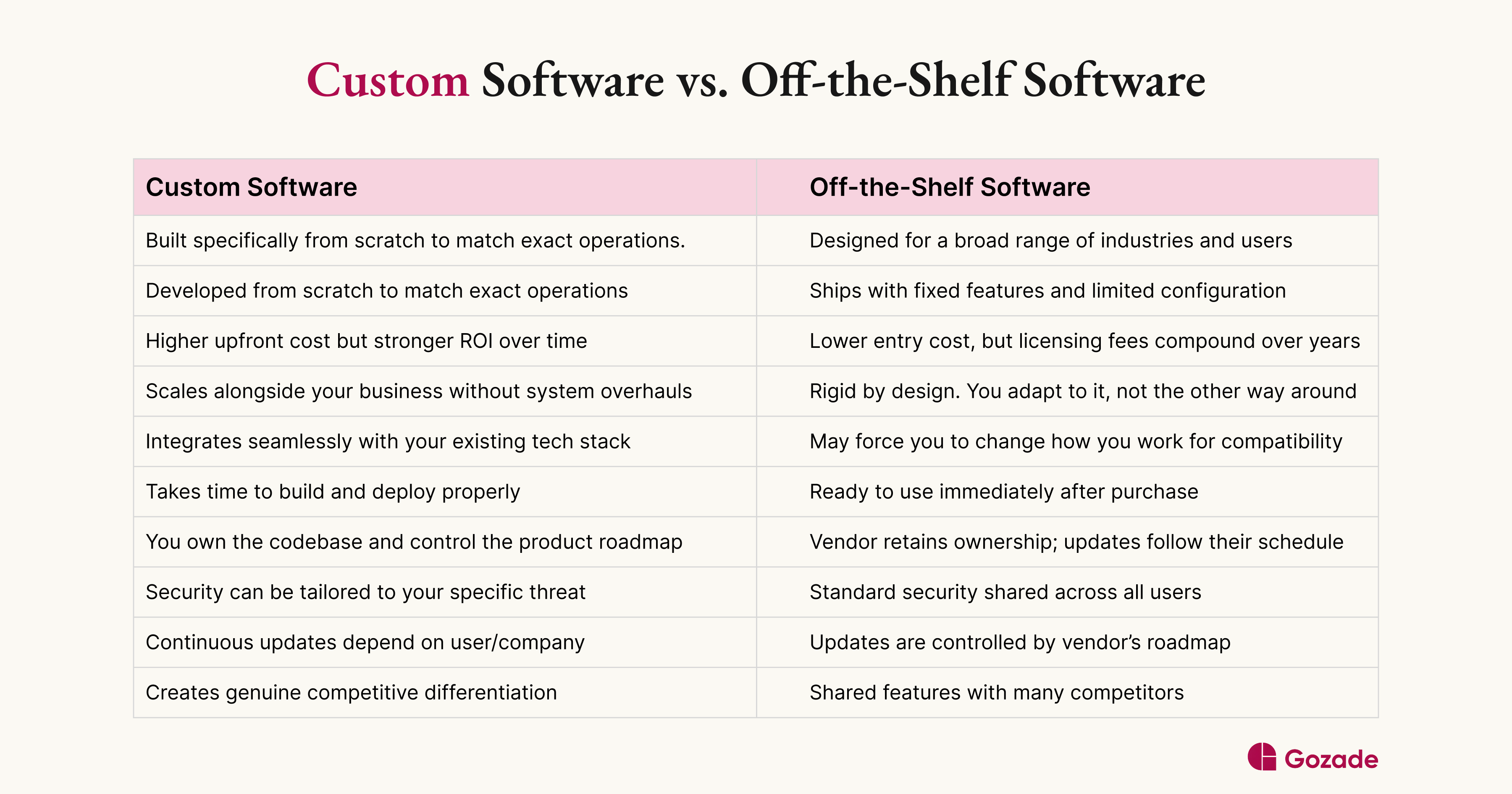
The central message is that off-the-shelf software is faster and cheaper to start, but it asks your business to conform to its logic. Custom software takes longer and costs more upfront, but it works the way your business actually works and it stays that way as you grow.
Types of Custom Software
1. Enterprise Software
Enterprise software is a large-scale system designed to support internal operations across multiple departments. It is mostly used by medium to large businesses that want a single unified platform to manage HR, finance, inventory, compliance, and customer operations.
A logistics company, for example, might build an enterprise system that tracks fleet movement, handles invoicing, monitors fuel consumption, and auto-generates delivery reports, all within one connected platform. Core capabilities typically include role-based access control, automated report generation, integrated HR and payroll modules, centralized data management, and compliance and audit logging.
2. Custom Content Management Systems (CMS)
A custom CMS allows businesses to manage digital content without depending on generic platforms like WordPress or Joomla. Businesses can create, manage, and modify content on their website without much technical know-how. The content management system handles all the basic tasks, helps teams focus on essential parts of the website. It is tailored for companies like Media outlets, e-learning platforms, or enterprise blogs that need specific publishing workflows, advanced permission settings, or multi-language support.
Core capabilities include custom publishing workflows, SEO tooling, scheduled publishing, multimedia editing, and granular user role management.
3. Data Analytics and Business Intelligence Tools
Custom analytics platforms are built to track the metrics that matter to your business, not the generic KPIs a standard dashboard was designed around. They are used by businesses that depend heavily on forecasting, operational performance data, or custom reporting.
Capabilities include real-time dashboards, predictive analytics, exportable reports, custom KPI filtering, and integrations with data sources such as CRMs, finance platforms, and e-commerce systems.
4. Custom E-Commerce Software
For businesses that have outgrown what Shopify or WooCommerce can offer, a custom e-commerce platform provides full control over the shopping experience, inventory management, pricing logic, and customer data. This custom platform is crucial for reaching international audiences, streamlining how inventory is handled, and creating a unique shopping experience for each user.
Core capabilities include secure payment gateways, real-time inventory tracking, customer behaviour analytics, mobile-optimized design, and flexible discount and promotions logic.
5. Custom CRM Software
Unlike off-the-shelf CRMs that come loaded with features you may never use, and missing the ones you need, custom CRM software is designed to match exactly how you manage relationships with leads, clients, and partners. It gives you full control over how you collect, track, communicate with, and retain customers.
Capabilities typically include custom sales pipeline stages, automated follow-ups, email and SMS integration, interaction history tracking, role-based dashboards for sales and support teams, custom segmentation logic, and API integration with marketing or billing tools.
Why Your Business Needs Custom Software
1. It is Tailored to Your Business’s Needs
Custom software is engineered around your specific challenges. It removes unnecessary features and aligns with how your team already works. This results in a system your staff adopt naturally, rather than one they work around.
2. It Scales With You
One of the most concrete benefits of custom software for growing businesses is scalability. As your business expands, so should your software. Custom software evolves with your business without requiring a complete system migration or the disruptive transition to a new platform.
3. It Drives Real Efficiency Gains
Tailored applications can automate repetitive manual tasks, reduce data entry errors, and streamline key workflows. By connecting with the tools your team already uses, custom software increases productivity across departments.
4. It Integrates Cleanly With Your Existing Stack
Most businesses already operate across multiple platforms, ranging from payment processors to customer relationship management tools. Custom software is built to integrate with all of them. This enables cleaner data flow, fewer duplicate entries, and saves the time lost switching between applications.
5. You Control Your Security
With custom software, security features can be built specifically for your business model and industry. You have control over data protection strategies, user permissions, and compliance requirements, helping you minimize risk and meet regulatory standards.
6. You Build a Competitive Advantage
When your competitors are all running the same generic platforms, differentiation becomes difficult. A custom solution gives you tools they do not have access to. This helps you with faster service delivery, more personalised customer experiences, and operational capabilities that are unique to your business.
7. It Becomes More Cost-Effective Over Time
While the initial investment in custom software may be higher, it often becomes more cost-effective in the long term. When you factor in custom software development cost vs ROI over a three-to-five-year horizon, the economics usually shift in favour of custom software as there are no recurring licensing fees, no paying for unused features, and maintenance that is focused and predictable.
8. Direct and Dedicated Support
Custom software comes with support from the team that built it. This ensures faster issue resolution, more relevant updates, and ongoing improvements tailored to your needs, not just generic patches pushed to thousands of clients at once.
Is Custom Software the Right Move for Your Business?
Custom software is not the right move for every business at every stage. This is why knowing when a business needs custom software is as important as understanding what it can do.
Before considering using custom software, determine if your current tools are slowing your team down; if you are regularly building manual workarounds for system limitations; if integration between platforms requires more effort than it should; or if your operations have become complex enough that generic software can no longer suffice.
The question is not whether custom software is good or not. It is whether your business is at the stage where the investment makes sense. For many businesses, especially those operating in sectors with complex, non-standard workflows, that stage arrives sooner than expected.
If you are tired of adjusting your operations around tools that were never built for your business, it is time to stop settling. At Gozade, we help businesses map out, build, and grow with software that actually works the way they do, irrespective of the type of tool involved. Let's talk.
Conclusion
Off-the-shelf tools are fine, until they are not. There comes a point where what once worked begins to slow your team down, limit your growth, or cost you more in compromises than it would to build exactly what you need.
Custom software puts you in control. It works the way you work, scales as your business scales, and saves you from paying for features you will never use. More than anything, it turns your technology into a strong leverage for growth.
FAQs
1) What is custom software? Custom software is a solution built specifically for a particular business or user. It is designed to solve your exact operational problems, not a generic set of problems shared by thousands of different companies. No unnecessary features, just the functionality your business actually needs.
2) What is the difference between system software and custom software? System software runs your device at the operating level. Windows, macOS, Android. You do not interact with it directly, but it keeps everything running. Custom software is built for your business operations: a sales tracking system, a booking platform, an internal dashboard, or a customer management tool tailored to your specific workflows.
3) What are real-world examples of custom software?
- Amazon: its e-commerce platform is entirely custom-built to manage its global product catalogue, logistics network, personalized recommendations, and fulfilment operations.
- Netflix: built its own custom streaming infrastructure to handle global content delivery, personalized viewing algorithms, and rights management at scale.
- Uber: relies on custom software for real-time ride matching, GPS tracking, dynamic pricing, driver ratings, and payment processing.
4) Why choose custom software over buying off-the-shelf? Off-the-shelf tools are built for the general public. That means you will always be adapting your workflow to fit the software rather than the reverse. Custom software inverts that: it is designed to fit your processes, not the other way around.
5) Is custom software worth the cost? For businesses that are serious about long-term efficiency and growth, yes. The upfront investment is higher, but you eliminate recurring licensing fees, avoid paying for unused features, and gain a system that evolves with your business rather than constraining it.
TAGS:
Build what matters, with Gozade
Let's Talk
Gozade
Address 1
3rd Floor, 86-90 Paul Street, London, England, United Kingdom, EC2A 4NE
Address 2
SUITE E141, IKOTA SHOPPING COMPLEX, VGC AJAH LAGOS, NIGERIA
+2349032770671, +44 7873272932
Gozade builds smart digital solutions that help businesses grow and scale with confidence.
© 2026 Gozade. All rights reserved.