
Insights
Articles
6 April 2026
8 min read
Do You Really Need AI? How to Know If Your Business Is Ready for AI Adoption
Praise Ohans
Author
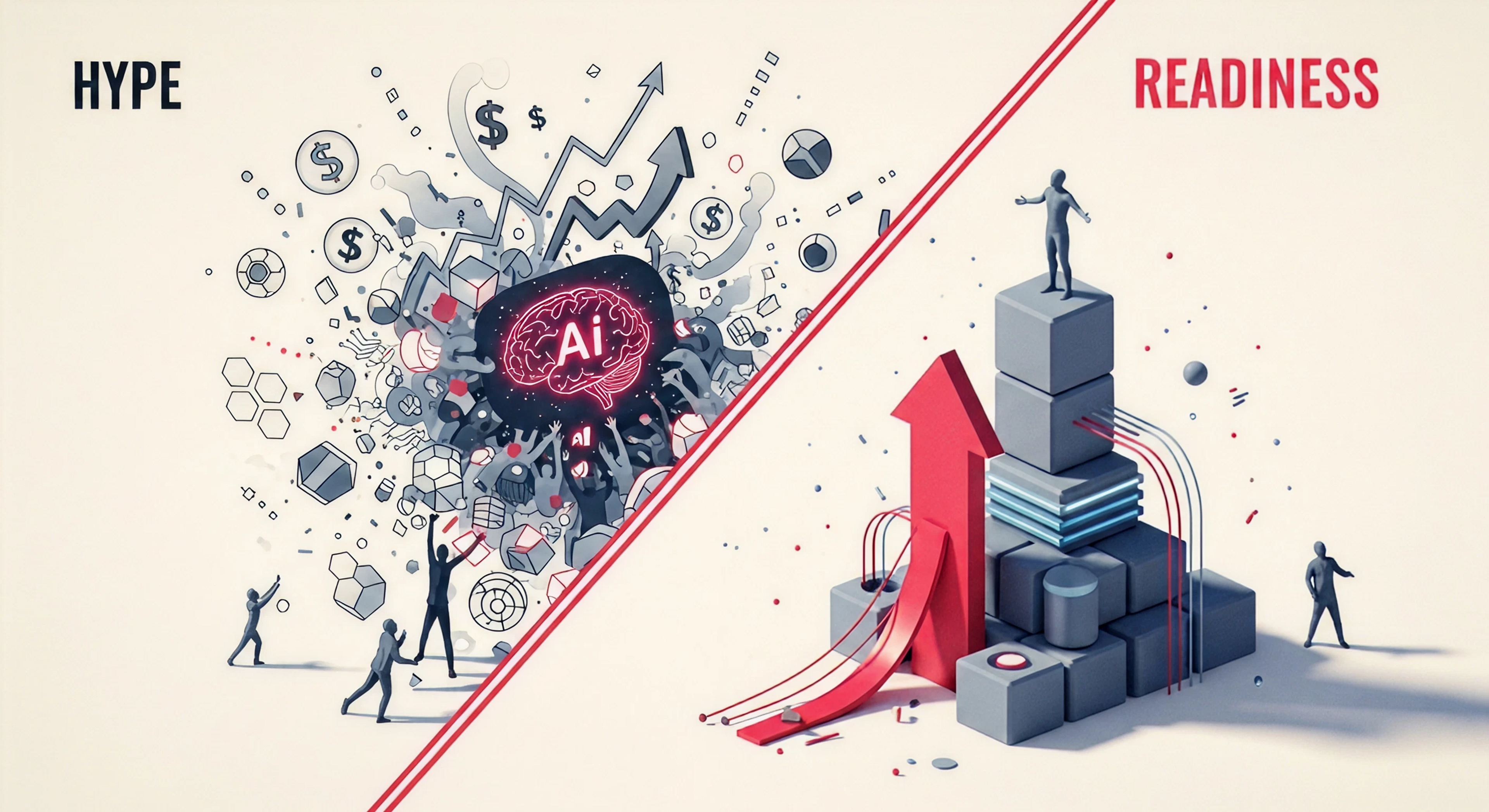
If you search “do I need AI for my business,” you’ll get the same anxious energy everywhere. AI is being pitched as what will magically fix every business need: cut costs, boost productivity, unlock growth. Hence, no one wants to lose out on “the next big thing”. What people fail to realize is that adoption is not the same thing as success. A lot of companies are using AI right now, but just a small number are actually seeing meaningful returns from it. Over 75% of companies now use AI in at least one business function. Logistics teams are running demand forecasts. Real estate firms are pricing properties with AI analytics. Healthcare networks are predicting patient no-shows. Everywhere you look, someone is adopting artificial intelligence and making it sound urgent that you do the same. The truth, however, is that 95% of enterprise AI initiatives deliver zero measurable ROI. MIT researchers call this the GenAI Divide, a widening gap between experimentation and real business value.
So before you sign up for another AI tool or run a pilot, the question to ask is not if you should use AI but if you are actually ready for it.
What "AI Readiness" Really Means
Most business leaders assume AI readiness is a technology question that revolves around their current software and infrastructure. Although this is a key part, it is not the starting point. AI readiness has more to do with capability assessment than a technology checklist. AI readiness has to do with assessing your organization’s capability across five dimensions:
- Purpose: Do you have a clearly defined problem that AI is meant to solve? Something specific, with a measurable outcome.
- People: Does your team understand how to work with AI? Are they trained, open to change, and aligned on why it is being introduced?
- Process: Are your workflows structured, repeatable, and documented? AI works best when it plugs into systems that already make sense.
- Platform: Do your current tools and infrastructure allow integration? AI needs a stable foundation to operate effectively.
- Performance: Can you measure success? Do you know what metrics will prove that the investment is working?
AI readiness involves having clean, accessible data, a clear business problem to solve, the right infrastructure, trained people, and governance structures before investing heavily. According to Gartner, 60% of AI projects fail due to a lack of AI-ready data alone. AI does not fix broken things; it only amplifies them. This means that if your data is incomplete, duplicated, outdated, or scattered across systems, AI will not clean it for you; it will learn from it and amplify it.
5 Signs Your Business Is Actually Ready for AI

It is okay to admit that not every business needs AI right now. But some businesses are in a position where AI would deliver. Here are the five clearest signals you are ready:
1. You Have Clean, Accessible Data.
AI is only as good as the data that feeds it. If your data is consistent, centralized, and structured, you are ready for AI integration, because well-governed data is AI-ready. Clean data for AI is more about trust than it is about storage. If your team trusts the data, AI can build on it. If they do not, every output becomes something to double-check. Once people start double-checking everything, efficiency takes a hit.
2. You Have a Clear, Specific Problem
AI works best when the problem is obvious. If you can describe the "before" and "after" in plain business language, then your business is ready for AI integration. Vague goals produce vague results. If you cannot describe the outcome in plain language, the use case is not ready.
3. Your Systems Can Handle Integration
AI does not operate in isolation. It needs to connect to your existing platform and infrastructure. Your existing system has to be stable and accessible. If your systems can share data, support APIs, and handle additional workloads, you have a workable AI infrastructure.
4. You Have Governance in Place
AI introduces speed. Governance brings control. With AI governance in place, you know who owns the system, how outputs are reviewed, and how errors are handled. An AI governance framework ensures that as AI scales, risk does not scale with it. It keeps decisions accountable and outcomes measurable.
5. There Is a Repetitive, High-Volume Problem to Automate
This is where you get the fastest wins with AI. Repeatable tasks like customer queries, document processing, data entry, and scheduling eat into valuable staff time. These are the strongest AI automation use cases because the value is immediate and measurable. With AI replacing manual effort, you improve speed and free up your team for higher-level work.
Red Flags: Signs You Are NOT Ready for AI

This is the section most AI vendors probably do not want you to read. Jumping into AI when these warning signs linger only leads to inefficiency and wasted budget.
1. Fear of missing out (FOMO)
If your main reason for adopting AI is because “everyone else is doing it”, then it is a waste of time. AI adoption should be strategic, and never be because of pressure from others. AI without a defined problem is nothing but an expensive experiment. AI implementation must be directly connected to real business outcomes.
2. Your Team is Not Ready
You may choose to install the best AI system in the world and still get zero value if your team is not on board. Only one-third of employees received AI training in the past year, despite 75% of companies adopting AI. Cultural resistance and poor change management are among the most consistent causes of AI project failure. Technology is always seen as the easy part, people are not. Train your team and communicate clearly with them. Show how AI fits into their work, not how it replaces them. AI Adoption must be managed strategically.
3. Your Budget Is Unrealistic
Entry level AI tools have become more affordable, but implementation still costs money. Data preparation, integration, training, and monitoring are costly. Little wonder why 55% of small business owners identify cost as a reason not to use AI. If the budget cannot support implementation, do not start yet; rather, build towards it.
The 4 Stages of AI Adoption: Where Do You Fit?
Not every business is supposed to be “AI-first” right now, which is fine. What matters is knowing where you are in the journey. Research from Kellogg Northwestern maps four stages of AI evolution for businesses.
Stage 1: The Cog (Basic Tasks)
This is where most businesses start. In this stage, AI helps with simple, repeatable tasks like writing first drafts, summarising documents, and generating ideas. It still requires constant human input. It is useful at this stage, but very limited.
Stage 2:The Intern (Support Role)
Now AI starts doing more meaningful work like drafting proposals, handling basic customer queries, and assisting with forecasts. It reduces workload, but still needs human supervision. This is where many small and mid-sized businesses operate today.
Stage 3: The Collaborator (Strategic Input)
At this stage, AI is no longer just executing tasks but contributing to decisions, analyzing tasks, identifying patterns, and suggesting opportunities. AI starts to feel like a peer in certain areas of the business. Getting to this stage requires strong foundations, clean data, and clear processes.
Stage 4: The Agent (Autonomous Execution)
This is the frontier stage. Here, AI systems operate with minimal human input. They are capable of running workflows, making decisions within defined boundaries, and executing end-to-end processes with minimal human input. Most businesses are not here yet.
How to Start: The Practical First Step
The best entry point for most businesses is what practitioners call “the narrow use case approach”. You choose one high-volume, well-defined, measurable problem, and start there. Most businesses get this wrong by trying to do too much too soon.
Before you purchase any tool, Gartner recommends that leaders define where they will and will not use AI in their enterprise. This prevents what researchers call "AI islands", which are disconnected experiments that generate scattered data and zero long-term value.
If your foundation is not there yet, see it as an advantage. This is the time for you to build properly while others are busy experimenting without structure. Start by ensuring your data is organized and accessible. Then, check out your processes, making sure they are clear and documented. AI performs best in environments where workflows already make sense.
Finally, align leadership to agree on business priorities. Teams need to understand direction because, without that, even the best tools will struggle.
FAQ Section
1. Do small businesses really need AI?
Not always. AI is most valuable when there is a clear, repetitive problem and the data to support it. Many small businesses benefit more from fixing processes before adopting AI.
2. How do I know if my company is ready for AI?
Look at your data quality, process clarity, team alignment, and ability to measure success. If those are in place, you are in a strong position to start.
3. What is the biggest risk of AI adoption?
The biggest risk is adopting AI without a clear use case or reliable data. This leads to wasted investment and little to no measurable return.
4. How much does AI implementation cost?
Costs vary widely, but the real investment goes beyond tools. Data preparation, integration, training, and ongoing monitoring are often the biggest expenses.
TAGS:
Build what matters, with Gozade
Let's Talk

Gozade
Address 1
3rd Floor, 86-90 Paul Street, London, England, United Kingdom, EC2A 4NE
Address 2
SUITE E141, IKOTA SHOPPING COMPLEX, VGC AJAH LAGOS, NIGERIA
+2349032770671, +44 7873272932
Gozade builds smart digital solutions that help businesses grow and scale with confidence.
© 2026 Gozade. All rights reserved.