
Insights
Articles
8 June 2026
5 min read
What Happens After MVP? The Next Steps Most Startups Get Wrong
Praise Ohans
Author
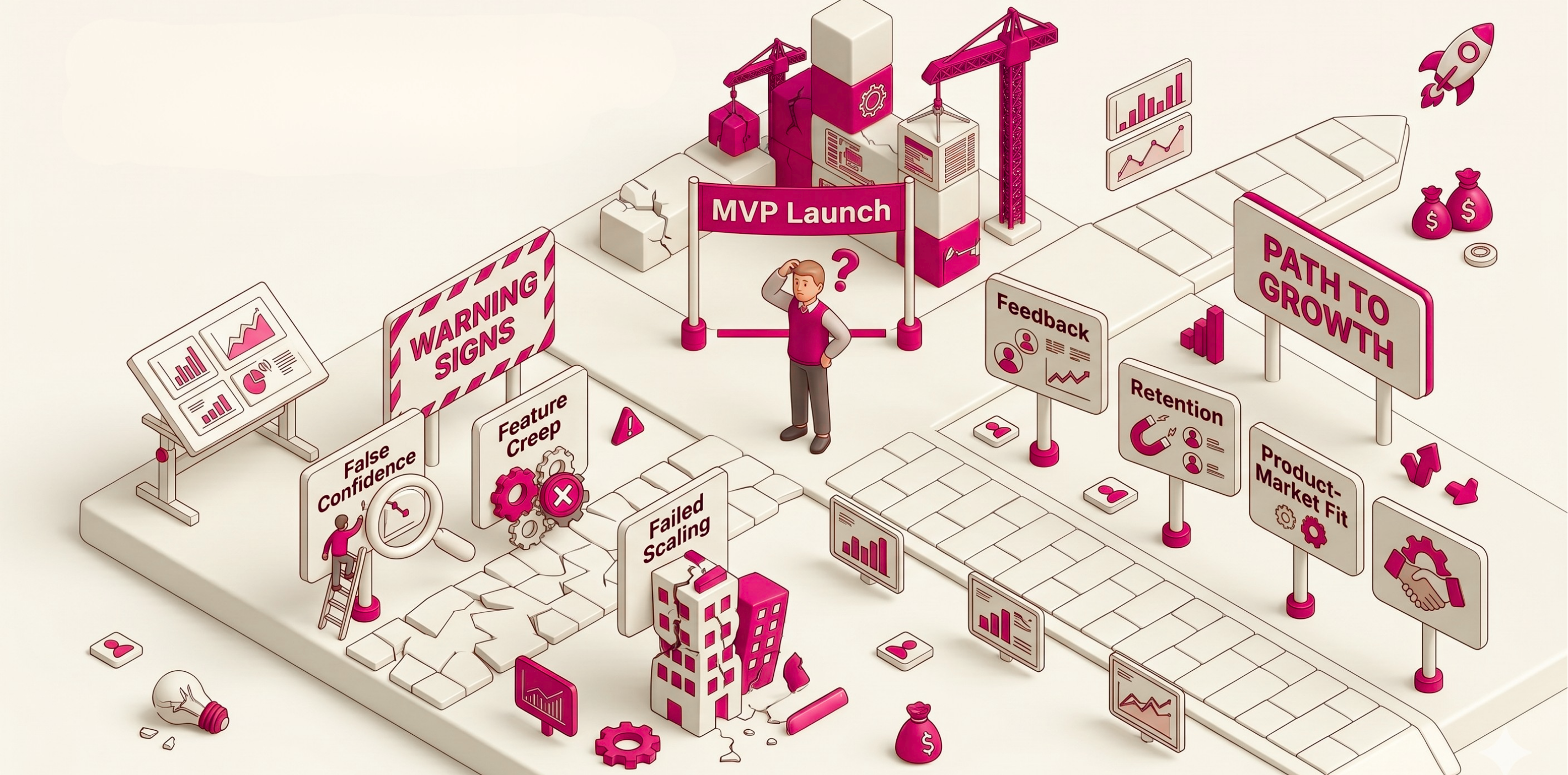
Launching a Minimum Viable Product can feel like crossing a finish line, but it’s just the starting point. The post-MVP strategy is crucial to whether a startup scales or stalls. According to CB Insights research, 42% of startups fail because there's no market need. This is a problem that surfaces right after MVP launch when founders misread early signals.
One of the biggest dangers after an MVP launch is false confidence. A few early users, friendly feedback, and a spike in traffic can make founders believe they have found the market, which may not actually be the case. This is why founders must focus on metrics like retention rate, qualitative feedback intensity, and willingness to pay.
- Retention rate: the percentage of users who return after using your product
- Qualitative feedback intensity: Not all feedback is equal in how they shape your product’s direction. Prioritize passionate complaints over lukewarm praise. For example, “I need this, but the payment page is buggy” beats “Nice product”.
- Willingness to pay: Free users can flatter you. Paying customers are proof that the problem is painful enough for someone to fund the solution.
Step 1: Build a Feedback Loop

After the MVP launches, founders are often in a rush to add more features. One user wants dashboards, another wants integrations. Someone wants dark mode, another wants an enterprise plan. To cap it all off, none of these users are on a paid plan. This is how products become bloated before they become valuable. Instead, build a structured customer feedback loop:
- Collect feedback from interviews, support chats, analytics, and onboarding calls
- Group requests by underlying problem
- Prioritize what improves activation, retention, or revenue
- Close the loop by telling users what changed and why
Tools like Productboard and Canny can help organize feedback. For prioritization, frameworks like RICE scoring help teams compare ideas by reach, impact, confidence, and effort.
For post-MVP work, do not blindly build what users request. Instead, build what solves the core problem.
Step 2: Sharpen Your Product-Market Fit Signals
Product market fit is measurable. One of the most practical ways comes from Superhuman’s product-market fit framework, which asks users: “How would you feel if you could no longer use this product?” If a strong percentage says, “very disappointed,” you may be onto something. If most users shrug, your product still sits in the mixed zone.
At this stage, improve the product’s core experience before expanding its features.
Focus on:
- Time-to-value: How quickly does a new user experience the “wow moment”?
- Activation: What action proves the user has understood the product?
- Retention: What brings them back without being begged?
- Frequency: How often does the problem occur in their life or workflow?
A good MVP iteration is not about adding more. It is about making the essential thing sharper, faster, and harder to abandon.
Step 3: Choose One Startup Growth Strategy
Once retention and activation show promise, you can begin testing growth. However, do not confuse growth with random motion. Most startups get this wrong by trying five channels at once: SEO, paid ads, LinkedIn, cold email, partnerships, influencers, events, etc. Choose one primary startup growth strategy based on your customer and business model:
Content-led growth: Works for B2B SaaS, searchable painpoints, and education-heavy markets.
- Product-led growth: Self-serve tools with collaborative products, low-friction onboarding
- Sales-led growth: Best for enterprise SaaS, complex deals, and high contract value
Brian Balfour’s work on growth and product-market fit makes clear that growth only works when it matches the product, market, and channel. A brilliant TikTok strategy will not save a product sold to CFOs. A 40-page whitepaper will not rescue a consumer app with a six-second attention span.
Step 4: Decide Whether to Build or Buy
It is normal for post-MVP startups to carry messy code, manual workflows, and compounding technical debt. However, it cannot stay that way forever. The key is knowing where to invest engineering time. Stripe's API-first approach succeeded because it built payment infrastructure while using AWS for servers. Build features that differentiate you and buy or integrate everything else: authentication, analytics, email delivery.
As a startup, you don’t have to build everything; you must know what to build and what not to build.
Step 5: Establish Unit Economics Early
Many founders delay financial modeling a little too late. After MVP, you need to understand whether your business can eventually make money per customer. The best approach is to start with the basics:
- Customer Acquisition Cost: How much does it cost to acquire one customer?
- Lifetime Value: How much revenue does one customer generate over time?
- Churn Rate: How many customers leave?
- Gross Margin: How much is left after delivering the product?
- CAC Payback Period: How long before you recover the acquisition cost?
SaaS Capital benchmarks show healthy SaaS companies recover CAC within 12 months. If your payback period exceeds 18 months, your model needs work before you scale.
Pivot vs Persevere Decision
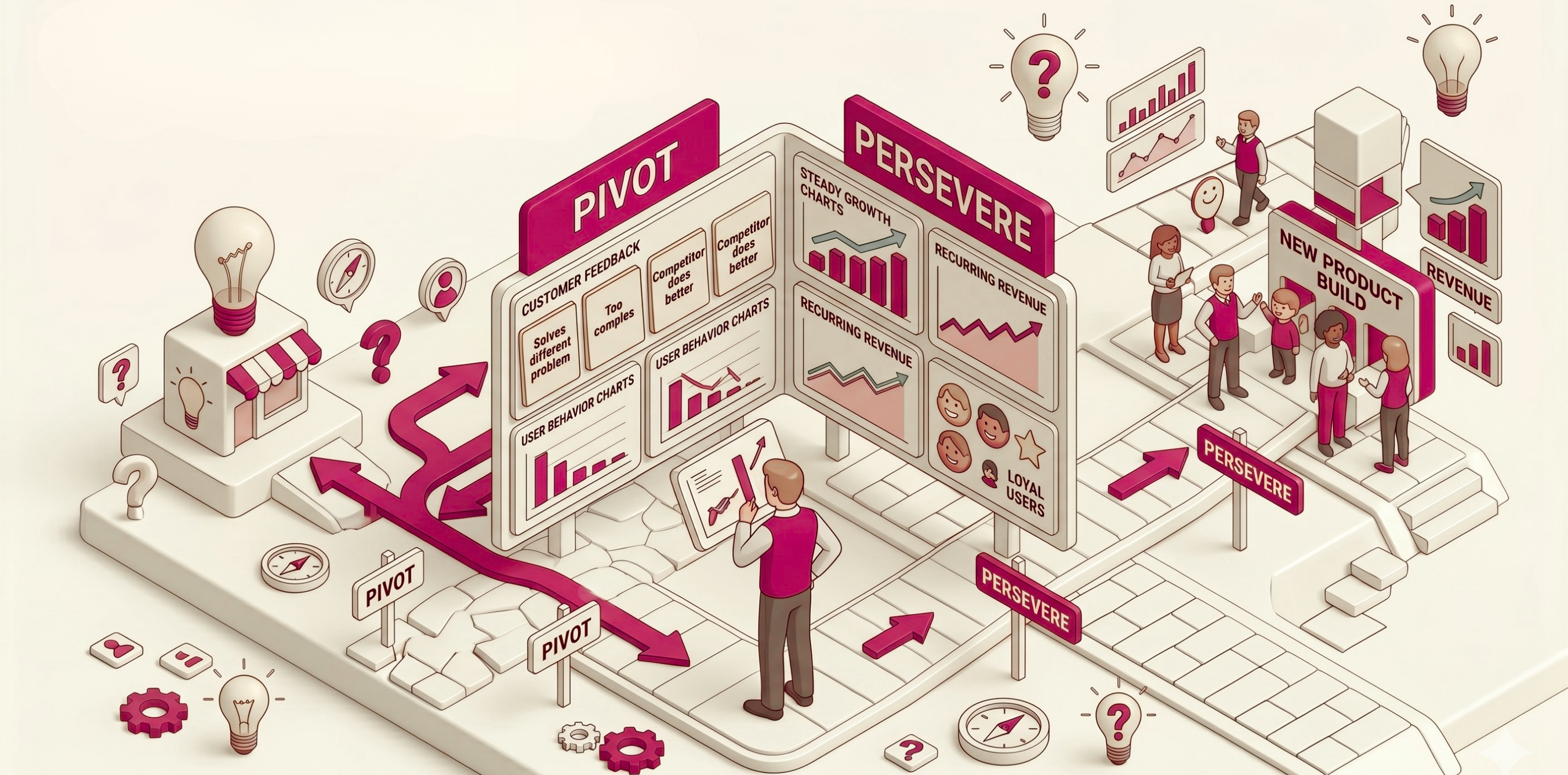
Almost everyone knows that not every MVP deserves a second act. However, the hard part is knowing whether you are facing a weak idea or just an unfinished one. The Lean Startup methodology calls this the pivot-or-persevere decision. Pivot signals are when your target users don't have the problem you're solving, or they have it but won't pay to fix it. Persevere signals occur when your users love your product, but adoption is slow due to distribution issues rather than product issues.
Pivot When:
- Users do not feel the problem strongly
- The target market will not pay
- Retention stays weak despite major improvements
- A different use case is getting more organic traction
Persevere When:
- A small group of users loves the product
- Retention is promising, but acquisition is slow
- Customers are paying, but positioning is unclear
- The problem is real, but onboarding needs work
Instagram is a classic example. It began as Burbn, a crowded social check-in app, before the team noticed users cared most about photo sharing and then pivoted. They didn't abandon their users; they followed their behavior. That is the founder’s job after MVP: listen to the market.
TAGS:


Build what matters, with Gozade
Let's Talk

Gozade
Address 1
3rd Floor, 86-90 Paul Street, London, England, United Kingdom, EC2A 4NE
Address 2
SUITE E141, IKOTA SHOPPING COMPLEX, VGC AJAH LAGOS, NIGERIA
+2349032770671, +44 7873272932
Gozade builds smart digital solutions that help businesses grow and scale with confidence.
© 2026 Gozade. All rights reserved.