
Insights
Articles
28 October 2025
6 min read
AI That Delivers ROI: How 30-Day Pilots Transform Operations and Support
Praise Ohans
Author
Introduction
We find ourselves in a time that is dominated by artificial intelligence. The statement “AI is coming to take your jobs” has already become cliche. The fact remains that those who do not take advantage of AI in their workflow would be replaced by those who do. Now, every organization wants to see AI deliver measurable ROI. Yet for many businesses, the path from AI adoption to actual return on investment remains unclear. Company executives understand that AI has the power to streamline workflows, improve customer support, and unlock new efficiencies, but proving its value before committing to a full rollout is usually where the challenge begins.
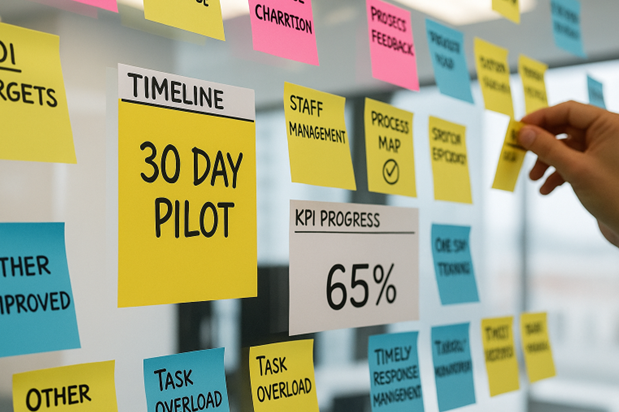
This is where the 30-day AI pilot comes in. This is a short, focused experiment that tests AI’s real-world impact in specific areas of operation. It works by concentrating efforts over a defined period of time. Companies can observe how AI improves workflow automation, reduces operational costs, enhances speed, and boosts quality; all within a single month. The results don’t reveal how AI creates measurable business value and where to scale next.
Why 30-Day Pilots Work
The appeal of a 30-day pilot lies in its simplicity and precision. Instead of investing heavily on large-scale AI deployments with uncertain payoffs, businesses use pilots as a low-risk, high-reward approach to test and measure results. It’s a way to validate AI ROI quickly, using real data from everyday operations. It works in four key steps:
Establish the Baseline
The process begins by mapping how work currently flows across systems, teams, and tools. Using methods like adaptive work intelligence, organizations connect this data to measurable KPIs like cost, speed, and quality, to understand their starting point.
Identify Leverage Points
Once the baseline is set, the next step is spotting where AI can make the biggest difference. This often includes automating repetitive, data-heavy tasks that slow productivity. These areas usually produce the fastest and most visible ROI.
Deploy and Observe
AI is then introduced in a controlled environment; small enough to manage, but large enough to produce meaningful insights. Continuous monitoring tracks improvements in execution, efficiency, and accuracy compared to the baseline.
Validate Impact
Finally, the outcomes are measured. Metrics like reductions in cycle time, cost, and error rates reveal whether the AI solution truly enhances performance. Strong results justify scaling across more teams or processes; underperforming ones help refine the next iteration.
The Reality of AI Implementation
The data surrounding AI adoption reveals both progress and pain points, and highlights why structured pilots are so crucial.
- 72% of organizations have now integrated AI into at least one business function, up from 55% the previous year.
- Nearly all companies report measurable ROI from their most advanced Generative AI initiatives, with 20% achieving returns above 30%.
- In healthcare, 63% of organizations have adopted AI automation, and 15% already report positive ROI.
However, behind these encouraging numbers is a cautionary finding. 42% of firms abandon most AI projects before full deployment , a jump from just 17% the year before. The reason is down to poorly designed implementations that skip the pilot stage, leading to unclear ROI, user resistance, and integration breakdowns.
A well-structured 30-day pilot closes this gap. It provides the clarity and confidence businesses need to move from experimentation to execution, ensuring AI initiatives don’t only start, but succeed, scale, and sustain measurable ROI.
Challenges in Delivering AI ROI Without Pilots
Despite AI’s proven potential, many organizations still struggle to see measurable returns on their investments. Large-scale AI deployments usually fail because they prioritize implementation speed over strategic validation. This results in costly systems that never reach full adoption or fail to align with business goals. Several factors are behind these challenges:
- Lack of Clear Measurement Frameworks: Many projects begin without defined KPIs, making it impossible to measure what success actually looks like. Without metrics like time savings, cost reductions, or accuracy improvements, results cannot be data-driven.
- Poor Workflow Integration: AI tools must fit seamlessly into daily operations. When they function in isolation or disrupt established processes, adoption slows, with impact being affected.
- Limited AI Literacy: Employees often lack the training to understand or trust AI-driven recommendations, leading to resistance and misuse.
30-day pilots address these challenges effectively. By starting small, companies can measureprogress incrementally, refine workflows, and validate impact before committing to full-scale deployment.
Operational and Support Transformation through AI Pilots
A well-executed AI pilot transforms how teams operate and serve their clients. In business operations and customer support, these short-term pilots often reveal how automation, prediction, and personalization drive measurable improvements in efficiency and satisfaction.
AI can handle high-volume, repetitive tasks like inquiry responses, and data entry. Predictive models anticipate system bottlenecks, while personalization engines tailor experiences in real time.
Real-world examples prove the value of this approach:
- Klarna achieved a 40% reduction in support cost-per-transaction after deploying an AI assistant that handled 66% of inquiries.
- Yum! Brands introduced AI-powered voice ordering, reducing errors by up to 20% and speeding up service by 10–15%.
- NIB Health Insurance saved $22 million and cut call volumes by 15% through AI chatbots and automated support workflows.
This shows how targeted pilots can help businesses manage cost effectively while also making room for growth by increasing customer retention and operational efficiency within short pilot periods.
Use Cases for Rapid ROI
When it comes to demonstrating AI ROI, speed is very vital. Short, focused pilots thrive on high-impact applications that show measurable business outcomes in weeks. The goal is not just to test AI for business value, but to prove, through numbers, that automation and intelligence can create immediate operational lift.
1. Lead Scoring Automation
Sales teams spend countless hours sorting through leads. With AI-driven lead scoring, organizations can narrow down prospective clients based on behavioral data, engagement history, and purchase intent.
2. AI Chatbots for Customer Support
AI chatbots have evolved from simple responders to intelligent virtual agents capable of handling complex queries. A well-designed pilot in this area can reduce average response times by 70%, cut call volumes, and improve customer satisfaction scores.
3. Content Personalization
Marketing teams can leverage AI to tailor content, offers, and experiences to individual users. Within a 30-day test window, companies often see click-through rate (CTR)improvements of 20–40%. One case study showed a 40% increase in CTR within just a few weeks of AI-driven personalization. Such results offer measurable proof that AI can create more human-centered engagement at scale.
Conclusion
AI that delivers ROI is all about precision, data, and proof. The 30-day pilot model provides that proof. It gives organizations a clear and measurable path to validate how AI impacts efficiency, cost, and customer experience before large-scale rollout. In lieu of endless discussions about potential, businesses gain tangible insights into what works, what doesn’t, and where to scale next.
When done right, these short, focused pilots turn AI into a business ally. They show that ROI from AI isn’t a long-term dream; it can be achieved in 30 days. By starting small, testing deliberately, and measuring rigorously, companies reduce risk while accelerating digital transformation.
TAGS:


Build what matters, with Gozade
Let's Talk

Gozade
Address 1
3rd Floor, 86-90 Paul Street, London, England, United Kingdom, EC2A 4NE
Address 2
SUITE E141, IKOTA SHOPPING COMPLEX, VGC AJAH LAGOS, NIGERIA
+2349032770671, +44 7873272932
Gozade builds smart digital solutions that help businesses grow and scale with confidence.
© 2026 Gozade. All rights reserved.